


How to Improve Creative Writing Skills in Kids: 5 Interactive Hacks
Overcoming the Blank Page Paralysis
When asked to write a creative story for school or home practice, many elementary students freeze up. Staring at a blank sheet of paper, worrying about correct spelling, or struggling to come up with plot ideas can make creative writing feel like an intimidating chore.
Creative writing resistance rarely means a child lacks imagination. More often, children feel overwhelmed by having to manage plot creation, character design, sentence structure, and mechanics all at once.
Parents can unlock their child's innate imagination by turning story creation into an interactive, step-by-step game.
1. Start with Self-Centric Character Creation
Every great story begins with a compelling main character. Children naturally find it much easier to brainstorm adventures when the protagonist is an idealized version of themselves.
Use simple creative writing activities for elementary kids to build characters:
• Custom Hero Avatars: Turn your child into a stylized 3D cartoon hero—such as a deep-sea explorer, superhero, or space scientist.
• Personal Goal Setting: Ask your child what problem their hero character needs to solve in the story.
2. Master Plot Sequencing with Interactive Sentence Drag-and-Drop
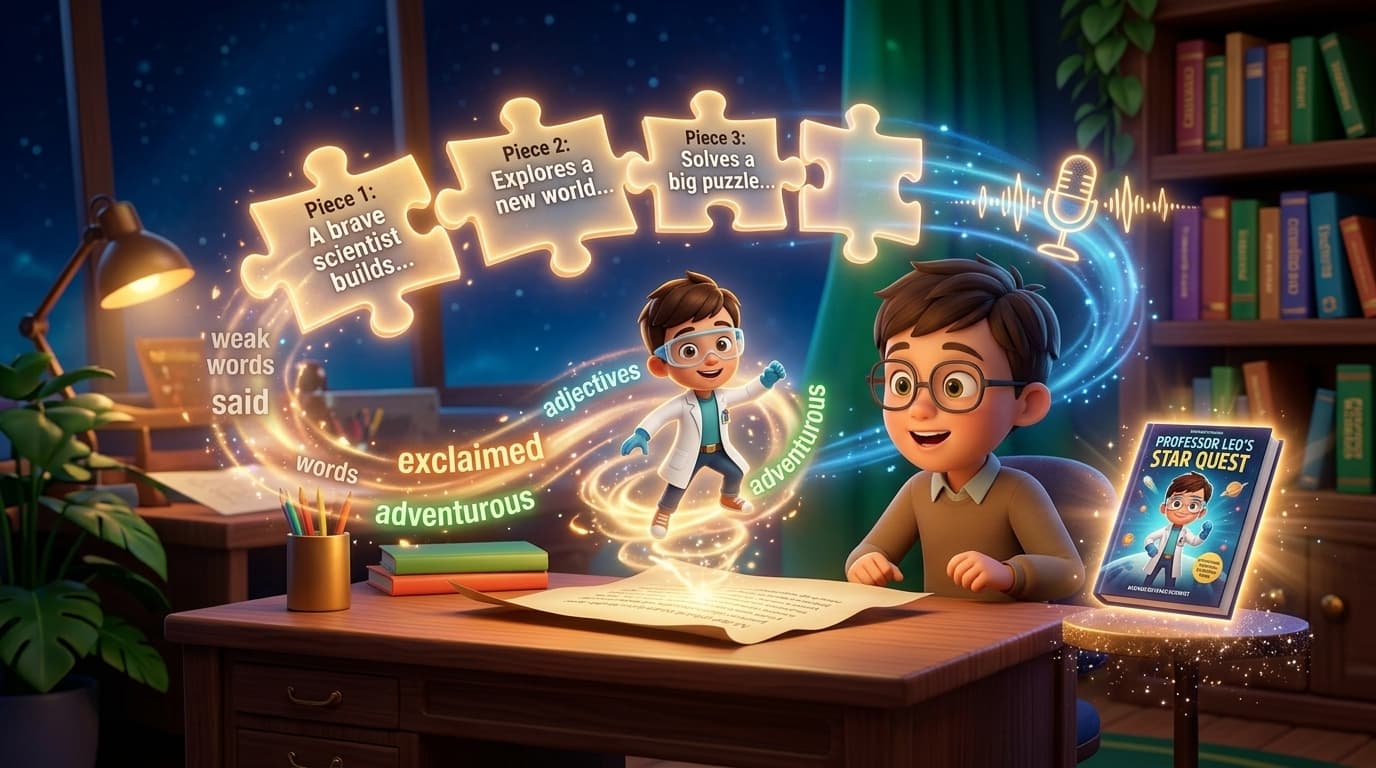
Understanding story arc structure—beginning, middle, and resolution—is fundamental for good writing. Instead of forcing kids to outline chapters on paper, use interactive sentence puzzles to demonstrate narrative flow.
Scrambling story events and having children drag and drop sentences into proper chronological order teaches them how plot transitions work in real time.
3. Expand Descriptive Vocabulary Through Context Challenges
Young writers often rely on repetitive words like 'good', 'bad', or 'said'. Expanding a child's descriptive vocabulary makes their written stories much more vivid.
Incorporate fun fill-in-the-blank quests where children replace weak words with colorful adjectives and strong action verbs (e.g., swapping 'walked' for 'sprinted' or 'navigated').
4. Use Voice Recording to Capture Oral Storytelling
Many children can tell elaborate, exciting stories verbally but freeze when forced to write those same thoughts down by hand. Handwriting speed often lags behind a child's fast-moving imagination.
Allow children to record their voice telling story ideas out loud into speech-to-text or voice-analysis tools. Capturing oral stories first removes mechanical friction, letting creativity flow freely.
5. Publish Your Child's Work as a Physical Hardcover Book
Nothing validates a young author more than seeing their written words bound inside a real, physical book. Turning digital story creations into hardcover keepsakes gives children immense pride in their creative writing abilities.
Displaying custom student-authored books on bedroom bookshelves or sharing them with grandparents turns writing into a celebrated milestone.
Ignite Your Child's Storytelling Journey with Littale
Discovering how to improve creative writing skills in kids is fun and intuitive with an interactive storytelling ecosystem. Littale.com brings child-led creativity to life.
Parents can transform their child's photo into a custom cartoon hero in under 3 minutes, generating a full 22-page personalized storybook. Equipped with 5 interactive AI Learning Quests—including Read Aloud speech diagnostics, Sentence Rearrange, True/False, Fill-in-the-Blanks, and Multiple Choice—Littale teaches narrative structure and language skills through play. Delivered as physical hardcover books via Lulu.com, Littale empowers every young reader to become a published author.
Comments(0)
No comments yet. Be the first to share your thoughts.