


How to Improve Reading Comprehension in Kids: 5 Hands-On Strategies That Work
The Reading Recall Disconnect
Many parents experience a puzzling phenomenon: a child reads an entire page aloud fluently, pronouncing every single word correctly, but cannot answer a single question about what just happened in the story.
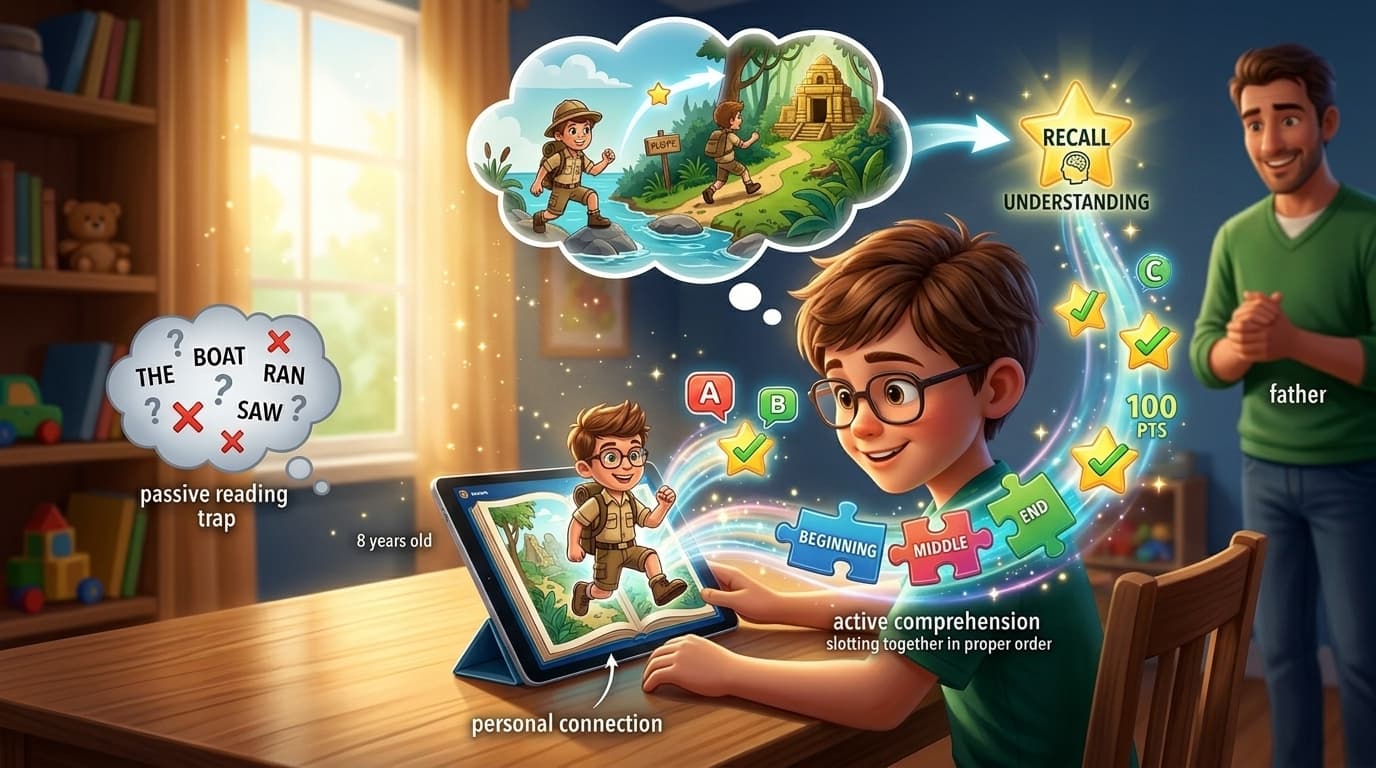
This gap happens when reading is treated as a mechanical decoding exercise rather than an active process of understanding plot dynamics. When children focus purely on vocalizing words, their minds fail to construct a mental model of the narrative.
To fix this disconnect, parents need practical strategies that turn passive decoding into active comprehension practice without resorting to dry test prep workbooks.
1. Use Story Sequencing to Master Plot Mechanics
Understanding story structure is essential for deep reading comprehension. When children learn to identify the beginning, middle, and end of a narrative, their ability to predict outcomes and recall plot points improves significantly.
Instead of asking open-ended questions like 'What was the story about?', try interactive story sequencing for kids:
• Sentence Rearranging: Write out 5 key plot points on separate sentence strips, mix them up, and challenge your child to reassemble them in chronological order.
• Plot Mapping: Have your child identify the main problem, the turning point, and the resolution after finishing a chapter.
2. Anchor Focus with Personal Character Connections
Children naturally pay closer attention to stories that directly reflect their own world. When a child sees themselves represented as the protagonist, their internal focus increases and memory retention improves naturally.
Using personalized educational storybooks for kids eliminates narrative detachment. When a child sees their own visual appearance starring across page illustrations as a superhero, explorer, or scientist, they become emotionally invested in the outcome of every sentence.
3. Replace End-of-Book Quizzes with Instant Micro-Checks
Waiting until the end of a long book to test comprehension often overwhelms young readers. By the time they reach page 20, they have forgotten what happened on page 3.
Incorporate quick, low-stakes reading comprehension activities throughout the story:
• True or False Sprints: Ask 2 fast true-or-false plot questions immediately after completing a page.
• Contextual Fill-in-the-Blanks: Omit key action verbs or vocabulary words while reading aloud and let your child guess the missing word using surrounding context clues.
• Multiple Choice Challenges: Provide three fun options for why a character made a specific choice during the chapter.
4. Practice Speech Evaluation and Auditory Feedback
Hearing their own voice while reading reinforces phonetic awareness and narrative flow. When children record their voice reading a short passage, they transition from passive text processing to self-monitoring.
Auditory feedback helps kids identify mispronounced words and awkward pauses on their own. Combining vocal practice with real-time feedback allows young readers to self-correct pronunciation before comprehension breaks down.
5. Explore Diverse Genres in Open Digital Libraries
Forcing children to read topics they find boring destroys intrinsic motivation. Providing access to a broad catalog of genres allows children to discover what genuinely excites them—whether it is deep-sea oceanography, space physics, or magical fantasy quests.
Before buying physical books, let your child explore free digital storybooks online to discover which themes capture their curiosity.
Transform Reading Comprehension with Littale
Implementing these child reading comprehension strategies does not require hours of prep work. Littale.com brings these active learning tools directly to your screen.
With Littale, parents can access hundreds of free books in the Open Library or transform their child's photo into a custom cartoon hero across a complete 22-page storybook in under 3 minutes. Every custom storybook comes paired with 5 interactive AI Learning Quests—including Read Aloud speech analysis, Sentence Rearrange, True/False, Fill-in-the-Blanks, and Multiple Choice challenges rated on a 100-point leaderboard.
Comments(0)
No comments yet. Be the first to share your thoughts.